

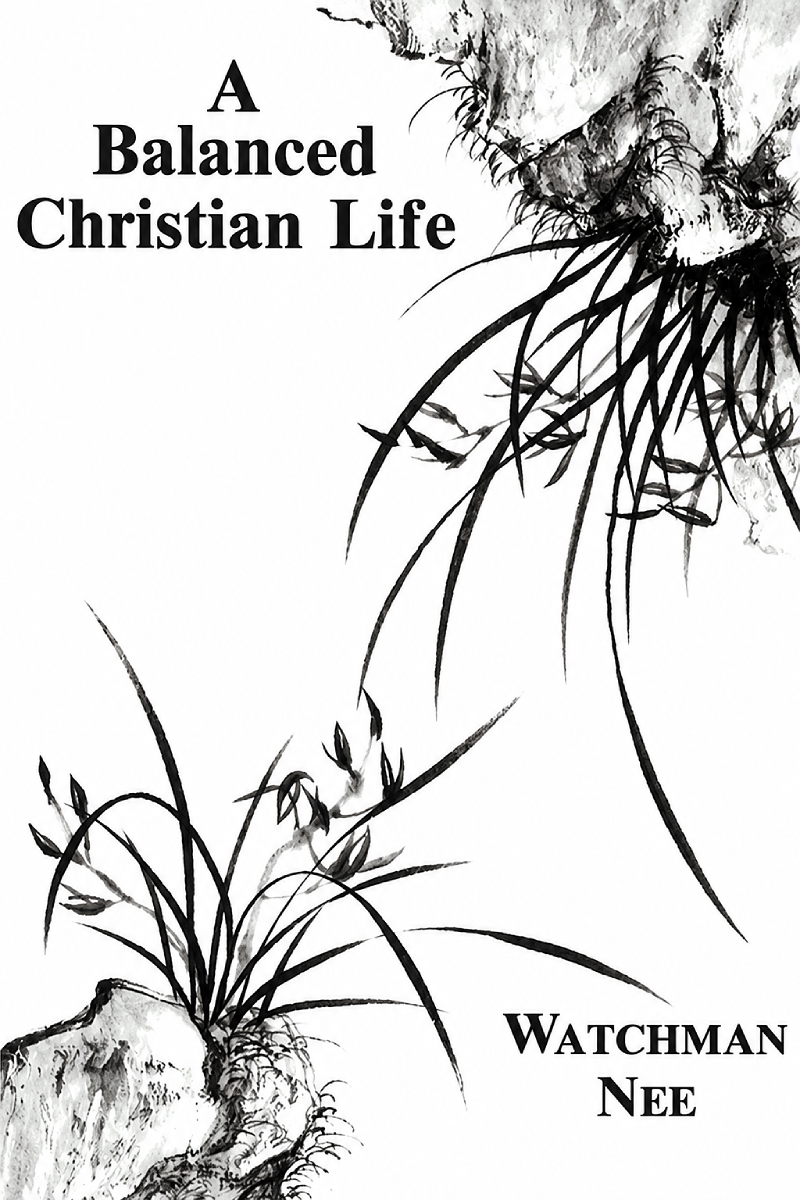
A Balanced Christian Life
Watchman Nee argues that mature Christian living requires the balance God gives His truth. Ten messages pair faith with obedience, objective truth with inward experience, God’s work with human response, rest with discipleship, and prayer with watchfulness, then apply that balance to restitution, meekness, spiritual poverty, faith, and the Cross-shaped path of growth.
Available Instantly
About This Book
“A Balanced Christian Life” collects ten messages in which Watchman Nee argues that Christian truth and experience must be held in the proportion God gives them. The governing problem is one-sidedness. Believers can emphasize a real truth so strongly that they neglect its corresponding side and become unbalanced in doctrine or practice. Nee therefore places complementary spiritual realities beside one another and asks how they work together in an actual Christian life.
Matthew 7:13–14 supplies the opening picture of the gate and the way. Nee applies the distinction to faith and obedience. There is a definite entrance into what God has provided and there is an ongoing walk in it. Faith includes a decisive act of believing God and a continuing attitude of trust; obedience likewise begins with a definite surrender and must continue in daily conduct. The chapter helps readers distinguish receiving a truth from walking persistently in what has been received.
“The Objective and the Subjective” develops one of the book’s most important distinctions. What God has accomplished in Christ is objective—outside the believer and complete in Him—while the Holy Spirit works those realities subjectively within the believer. Nee uses Christ’s death and resurrection, justification and regeneration, and the relation between being in Christ and Christ living in the believer to show why neither side can replace the other. Faith rests on the finished work of Christ; obedience responds to the present work of the Spirit.
Philippians 2:12–13 then provides the framework for “Work In and Work Out.” God is the source who works within, yet the believer is called to work out what God supplies. Nee rejects both self-powered Christian effort and a passivity that refuses human response. The same concern shapes “Rest Given and Rest Found” from Matthew 11:28–30. Christ gives rest to the burdened person who comes to Him, but the disciple also finds rest by taking Christ’s yoke, learning His meekness, and accepting God’s practical dealings.
“Watch and Pray” joins dependence on God with spiritual vigilance. Prayer must be accompanied by alertness to temptation, the weakness of the flesh, and the pressure of the enemy. The point is not anxious self-protection but watchful dependence upon the Lord.
Leviticus 6 governs the message on the trespass offering. Nee distinguishes forgiveness before God from the practical responsibility to make wrongs right with people. The blood of Christ is the basis of forgiveness, while trespasses against others may require confession, repayment, restitution, and restoration of fellowship. Old Testament offerings are therefore used as biblical types that clarify Christian responsibility after salvation.
The messages on meekness and spiritual poverty expose subtler forms of imbalance. Moses illustrates how natural wisdom and strength must be dealt with so that a servant relies on God rather than the flesh. Revelation 3:17 supplies the warning of Laodicean poverty: the more dangerous condition is not merely lack, but being poor while imagining oneself spiritually rich. True growth requires a realistic recognition of need.
The final two messages return to faith and progress. Faith rests on what God has spoken rather than on feelings or visible circumstances. The closing study of 2 Kings 2 uses Elijah’s last journey with Elisha—Gilgal, Bethel, Jericho, and Jordan—as a sequence of spiritual pictures concerning the flesh, the world, Satan, and death. Nee stresses that victory rests on what Christ has accomplished and becomes experiential as the believer walks in faith and under the working of the Holy Spirit.
The book answers practical questions such as: How do faith and obedience fit together? How does Christ’s finished work become inward experience? What does it mean to work out salvation if God is the One working within? How are salvation-rest and discipleship-rest different? Why must prayer include watchfulness? When does forgiveness require restitution? What is biblical meekness? How can a Christian recognize spiritual poverty? And how do the Cross, faith, and the Spirit produce a balanced path of growth?
Book Details

Reading Fit
STUDY LEVEL
Fundamental, Intermediate
STUDY SCOPE
Topical
BOOKS INCLUDED

Edition & Format
PUBLISHED
October 7, 2009
AVAILABLE FORMATS
paperback, kindle, audiobook
LENGTH
195 pages
· 4h 40m audio

Topics Covered
You Might Also Like