

In This Article

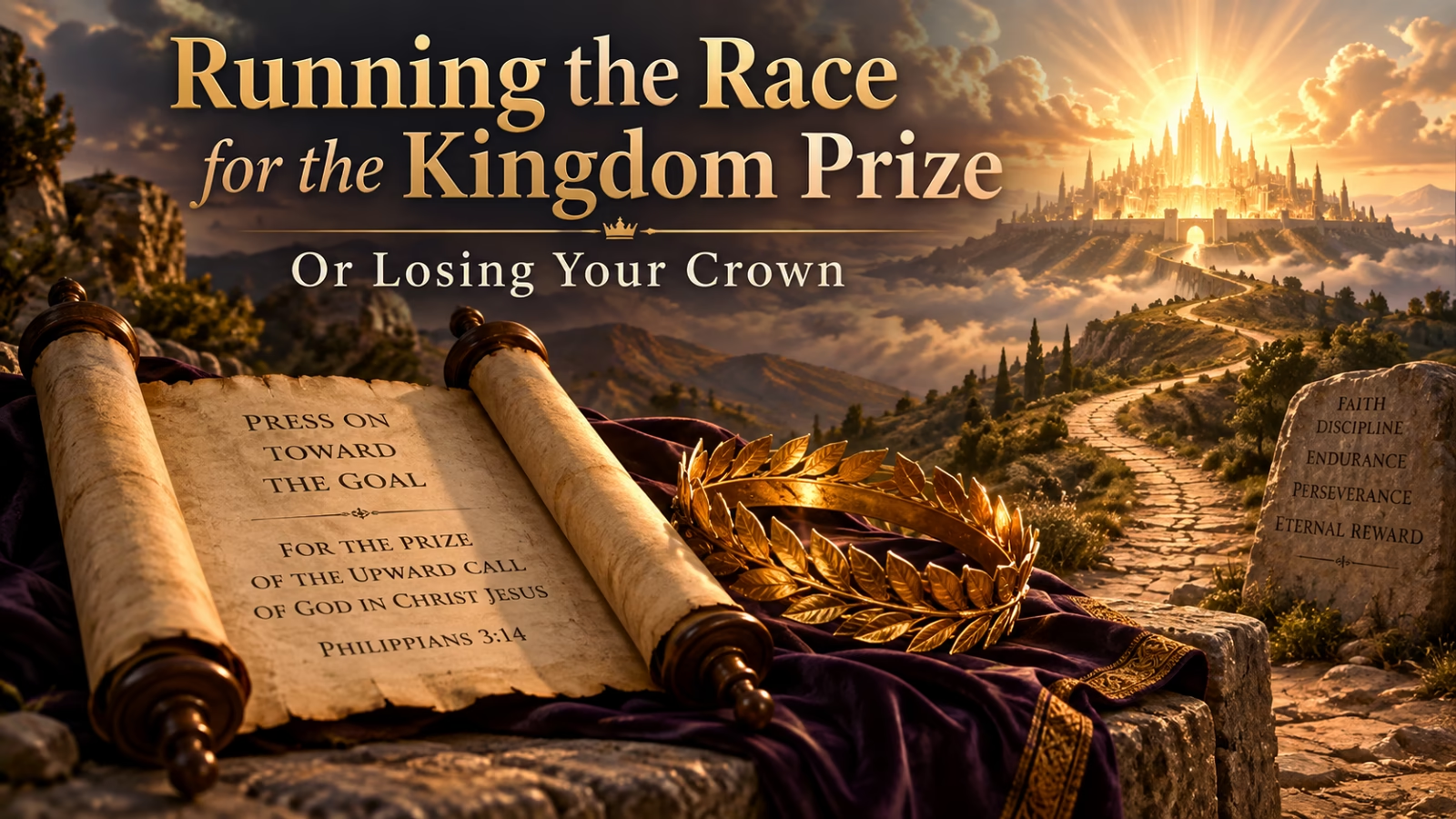
Running the Race for the Prize: Or Losing Your Crown
Running the Race
The apostle Paul made a statement in 1 Corinthians that should stop every believer in their tracks. He compared the Christian life to a race, told the runners to run that they might obtain the prize, and then applied the warning directly to himself.
“Do you not know that in a race all the runners run, but only one receives the prize? So run that you may obtain it. Every athlete exercises self-control in all things. They do it to receive a perishable wreath, but we an imperishable.... I discipline my body and keep it under control, lest after preaching to others I myself should be disqualified.”
— 1 Corinthians 9:24–27
Those words came from an Apostle of Jesus Christ. Paul was not an unbeliever wondering whether God would save him. He had received Christ, preached Christ, suffered for Christ, planted churches, and had already taught that justification and eternal life rest in God's grace rather than human merit.
Yet Paul still believed that he could be disqualified.
Disqualified from what?
That question opens a doorway to a deeper message in the New Testament that we will consider in this post.
Paul was not running to become a child of God. He was already a child of God. He was running because something had been placed before God's children that will be obtained—or lost. Something Paul called "The Prize".
A Gift and a Prize Are Not the Same Thing
Scripture does not speak about eternal life and the prize in the same way. Eternal life is God's gift in Christ. Paul says plainly that “the free gift of God is eternal life in Christ Jesus our Lord” (Romans 6:23). A gift is received because of the giver.
But in 1 Corinthians 9, Paul does not say, “Receive the prize as a free gift.” He says, “Run that you may obtain it.” He speaks of self-control, discipline, purposeful running, an imperishable crown, and the possibility of disqualification.
That distinction matters. If salvation and the prize are made identical, Paul is reduced to telling people already saved by grace to run to obtain the salvation they already possess. Worse, his warning would mean that after preaching salvation to others, he feared Christ might revoke his own salvation.
But Paul himself gives us another category—one that allows both the security of God's salvation and the seriousness of the warning to remain intact.
Saved, Yet Suffering Loss
In 1 Corinthians 3, Paul describes a coming examination of the believer's work. Christ is the foundation. Upon that foundation, believers build. Some work survives the fire; some does not.
“If the work that anyone has built on the foundation survives, he will receive a reward. If anyone's work is burned up, he will suffer loss, though he himself will be saved, but only as through fire.”
— 1 Corinthians 3:14–15
That sentence establishes a biblical category that must control how we read the warnings to believers: a person can be saved and still suffer real loss.
The loss cannot be salvation, because Paul explicitly says that the person himself will be saved. Yet the loss cannot be imaginary, because Paul explicitly says that he will suffer it. Scripture therefore gives us both truths at once: salvation remains, and loss is real.
This is exactly what 1 Corinthians 9 requires. Paul can belong to Christ and still fear disqualification. The cross does not fail. Eternal life does not become temporary life. A child of God does not cease to be God's child. But a saved believer can still reach Christ's examination and suffer loss.
The Judgment Seat of Christ
The race has a finish line, and Paul tells us where the runner is examined.
“For we must all appear before the judgment seat of Christ, so that each one may receive what is due for what he has done in the body, whether good or evil.”
— 2 Corinthians 5:10
Paul includes himself: we must all appear. Romans 14:10–12 gives the same warning: we will all stand before God's judgment seat, and each of us will give an account of himself to God.
This is not the Great White Throne of Revelation 20:11–15, which appears after the thousand years. This is Christ's examination of His own people—those whose standing with God rests on His blood. Their sin debt is not being tried again as though the cross had failed.
What is being examined is the believer's life, faithfulness, obedience, and response to the grace and responsibility entrusted to them.
The Great White Throne is a different judgment, ending in the lake of fire for those not found in the Book of Life.
The judgment seat of Christ concerns those who belong to Him, and they will either receive reward, loss, approval, and Kingdom inheritance or will be sent to outer darkness, not fire, where there is great regret and gnashing of teeth. There is no darkness in New Jerusalem; all of God's children will be there at that time. Salvation will never be lost.
That explains Paul's seriousness. Public ministry does not automatically equal personal approval. An Apostle can preach to others and still be disapproved of receiving the prize. The judgment seat of Christ is where the race runner is evaluated and where reward or loss becomes concrete.
The Judgment Does Not Create Maturity
The judgment seat also exposes something else important: the judgment seat alone does not magically mature an unfinished believer. A person who resisted God's transforming work according to God's way during this age, the age of Grace, does not become fully prepared merely because they died, were raised, and stood before Christ.
That matters because the Kingdom is not the final New Jerusalem. The thousand years stand between Christ's return and the completed eternal city. If some of God's children reach the judgment seat unfinished, God's purpose for them is not abandoned—but neither can their unfinished condition simply be ignored, for New Jerusalem cannot be completed with imperfection.
What Is the Prize?
If the prize is not eternal life and all that Jesus promised to those who believe in him, what is Paul running to obtain?
It can't be New Jerusalem, for all the children of God will be there, a new creation in Christ, fully perfected by God, living stones used to build God's eternal habitation, i.e., His home. And again, salvation cannot be lost.
The New Testament answers progressively. Paul connects the prize with resurrection attainment and reigning. Jesus connects overcoming with the tree of life, white garments, the crown, authority over the nations, the throne, and freedom from the second death. Revelation 20 then gathers these promises into the thousand-year reign.
Paul Had Not Yet Attained the Out-Resurrection
Philippians 3 is one of the most important passages in the discussion because Paul knew he would be raised from the dead. Yet he still speaks about attaining to a resurrection that he had not yet attained.
“That I may know him and the power of his resurrection, and may share his sufferings, becoming like him in his death, that by any means possible I may attain the resurrection from the dead. Not that I have already obtained this or am already perfect, but I press on.... I press on toward the goal for the prize.”
— Philippians 3:10–14
The expression translated “resurrection from the dead” uses the unusual Greek word exanastasis—an out-resurrection, a resurrection out from among the dead. The word occurs only here in the New Testament.
We should not build the entire argument on one Greek term, and we do not need to. The context supplies the force. Paul says attain. He says not already obtained. He says press on. He speaks of a goal and a prize.
Paul was not uncertain that Christ would raise him. He had already taught in 1 Corinthians 15 that the believers remaining at the last trumpet would be raised and changed into immortality.
What he had not yet obtained was the resurrection from the dead, a different resurrection that he describes in Philippians 3:10 that can only be attained through the successful completion of the race. That is why Philippians 3 cannot simply be reduced to the guaranteed resurrection and change he describes elsewhere. Paul already knew that he would be resurrected with everyone else.
Paul Was Guaranteed Resurrection—But He Pursued a Better Resurrection
Paul expected to die before Christ's return. He therefore knew he would need resurrection simply to stand with the other believers before Christ. Yet that guaranteed resurrection was not what occupied his heart in Philippians 3. In 1 Corinthians 15 he could include himself in the promise that mortality would put on immortality and that God's people would be changed. Here, however, he speaks of something he had not yet attained and must press toward. The distinction is not between resurrection and no resurrection, but between the change promised to God's children and the out-resurrection bound up with the prize.
That distinction becomes clearer when Revelation 20 describes the first resurrection not merely as people becoming alive, but as a resurrection surrounded by privilege: those who share in it are called blessed and holy; the second death has no authority over them; they are priests of God and of Christ; and they reign with Christ for a thousand years.
Paul wanted that resurrection—the resurrection of the finished runner, the approved servant, the overcomer prepared to enter the Kingdom inheritance.
“If We Endure, We Will Also Reign”
Paul states the governmental side of the prize plainly:
“If we endure, we will also reign with him.”
— 2 Timothy 2:12
The sentence contains a condition. Paul does not say, “Because we are saved, we automatically reign.” He says that endurance is connected with reigning.
The pieces now begin to lock together: run so that you may obtain; do not be disqualified; press toward the prize; attain the out-resurrection; endure so that you may reign.
Jesus then gives the same truth from the other side. Instead of using Paul's word endure, He repeatedly speaks of the one who overcomes, who is a victorious racer.
What Jesus Promised the Overcomers
Revelation 2 and 3 are messages from the risen Christ to churches. The warnings are not addressed to pagans. Again and again Jesus says, “He who has an ear, let him hear what the Spirit says to the churches.” Again and again He places a conditional promise before the one who overcomes.
Those conditions must mean something. If the non-overcomer automatically receives everything promised to the overcomer, the warnings collapse into empty words. Jesus does not speak that way. At the same time, Jesus is speaking to all the churches, including yours.
The Tree of Life
“To the one who is victorious I will grant to eat of the tree of life, which is in the paradise of God.”
— Revelation 2:7
In the New Jerusalem, the tree of life is part of the completed eternal scene. But here Jesus specifically promises its fruit to the victorious overcomer. The promise therefore points to an early Kingdom enjoyment of what will eventually belong to God's completed eternal purpose.
The implication is unavoidable: during the period in which this remains an overcomer reward, the non-overcomer does not share that fruit. Otherwise Christ has promised the overcomer nothing distinctive.
The Second Death
“The one who overcomes will not be hurt by the second death.”
— Revelation 2:11
This is one of Christ's most sobering statements to the churches. Jesus does not merely warn about losing a lesser reward; He names the second death.
If the overcomer is specifically promised that the second death will not hurt him, then the believer who fails to overcome faces the opposite danger: they can be hurt by the second death. Otherwise Christ's condition has no meaning. The warning must be allowed to carry the full weight Jesus gave it.
That does not make the warning a statement of eternal loss, but neither does eternal security make the warning harmless. Jesus chose the language of the second death for a reason, and the believer should fear the judgment Christ Himself says can hurt the one who does not overcome. First Corinthians 3 has already established the category: saved, yet suffering loss. Christ's saving work and Christ's disciplinary judgment must both be allowed to stand.
Revelation 20 repeats this same exemption in connection with the first resurrection: over those who share in it, the second death has no authority. Revelation 2 gives that protection to the overcomer; Revelation 20 shows it realized in the thousand-year Kingdom. The connection is deliberate. The overcomer enters that age beyond the reach of the second death, while the believer who fails to overcome is not given that exemption.
The Hidden Manna and the White Stone
“To the one who conquers I will give some of the hidden manna, and I will give him a white stone, with a new name written on the stone that no one knows except the one who receives it.”
— Revelation 2:17
The hidden manna becomes especially significant when read against the Tabernacle. All Israel ate manna in the wilderness, but a preserved portion was placed before God and eventually associated with the Ark in the innermost sanctuary (Exodus 16:32–34; Hebrews 9:4).
So the promise is not merely “food,” but a special portion available only to the overcomers. It points toward a reserved portion connected with nearness to God.
The white stone and new name are likewise one-on-one personal and conditional. Christ promises the victorious runner something that is not simply the common possession of every believer by virtue of salvation during the Kingdom age.
Authority Over the Nations
“The one who is victorious and who keeps my works until the end, to him I will give authority over the nations.”
— Revelation 2:26
This promise is unmistakably governmental. The victorious overcomer will share Christ's authority over the nations. That is exactly what Paul means when he says, “If we endure, we will also reign with Him.”
The Kingdom reward is therefore not merely a private feeling of approval. It includes actual participation in Christ's government. The opposite is equally real: the believer who does not overcome and keep Christ's works to the end is not given authority over the nations and does not share the overcomer's place in the millennial government.
White Garments and the Book of Life
“The one who overcomes will be clothed in white garments, and I will never blot their name out of the book of life. I will confess their name before my Father and before his angels.”
— Revelation 3:5
Again, the promise has an opposite side. The overcomer is clothed in white; the defeated believer is not clothed in that white garment. The overcomer's name is not blotted out; the warning therefore carries the real consequence of blotting for the one who fails to overcome. The overcomer is confessed before the Father; the defeated believer does not receive that public acknowledgment. This gives real force to Christ's words, “I never knew you,” toward those who invoke His name yet are not acknowledged by Him. Saying “Lord” and doing works in His name are not substitutes for keeping His word and remaining under His rule in Spirit according to Romans 8. Christ presents these as actual consequences, not rhetorical flourishes.
This cannot mean eternal loss of salvation without breaking other Scripture, but that does not make the blotting unreal or harmless. Jesus says He will lose nothing the Father has given Him (John 6:39). Paul says a believer can suffer loss and still be saved (1 Corinthians 3:15). The New Jerusalem is the completed habitation of God, not an eternal city containing some of Christ's redeemed children while others remain permanently erased. Scripture therefore requires us to hold both truths without weakening either one: the believer may face the terrible Kingdom consequence Christ describes, and Christ will still complete His final purpose in those who belong to Him.
The blotting therefore belongs to the period of Kingdom reward or loss. It is devastating, but not eternal. The believer who failed to overcome is excluded from the Kingdom for which he was called to qualify; he does not receive its white garment, its public acknowledgment, or its reigning position. Yet God's final purpose for that child remains intact and will be completed before the New Jerusalem.
Hold Fast So No One Takes Your Crown
“I am coming soon. Hold fast what you have, so that no one may seize your crown.”
— Revelation 3:11
A crown that cannot be lost does not need to be guarded. Jesus tells faithful saints to hold fast so that no one takes theirs.
The Church in Philadelphia
Philadelphia is especially instructive because Christ has no rebuke for the church. They are not being told to recover what they have lost or repent of a path that has gone wrong. They have kept His word, have not denied His name, and have endured patiently. They are already walking in a condition the Lord approves.
Philadelphia itself means brotherly love, fitting the Lord's command that His disciples love one another and make His life visible among them (John 13:34–35).
What does hold fast mean?
Positively, to hold fast means continuing in everything Christ commends: keeping His word, remaining faithful to His name, enduring patiently, and preserving that brotherly love. Negatively, it means refusing to fall into the errors of Ephesus, Pergamum, Thyatira, Sardis, and Laodicea. Their command is simply: hold fast. Continue. Endure. Finish.
Paul says, “Run that you may obtain.” Jesus says, “Hold fast so no one takes your crown.”
Philadelphia shows what running the race successfully looks like in practice.
Keeping His word and not denying his name go together and have more to do with what flows from the heart than from the mouth.
Faithfulness to His name is more than saying the right words about Jesus while living outside His rule in the errors of the other 5 churches. He Himself asked, “Why do you call Me ‘Lord, Lord,’ and not do what I tell you?” (Luke 6:46), and Matthew 7 warns that even works done in His name cannot substitute for obedience.
Philadelphia is therefore the positive model: keep His word, remain true to His name, endure, love the brethren, and refuse to participate in what Christ condemns.
The 5 churches Jesus has issues with show the roads by which the crown can be lost. Smyrna shows that anyone who gives their physical life up for the Lord will automatically be victorious; and Philadelphia shows the path that leads to victory and the crown!
Sit With Me on My Throne
“The one who overcomes, I will grant him to sit with me on my throne, as I also overcame and sat down with my Father on his throne.”
— Revelation 3:21
The sequence of the seven churches reaches its climax at the throne.
Tree of life. Hidden manna. White garments. The Crown. Authority over nations. The name of the New Jerusalem and the Throne.
These are not scattered prizes unrelated to one another; Paul speaks of the prize, singular, and Revelation 2–3 unfolds its different aspects. Together these promises describe participation in Christ's own overcoming victory, not merely escape from judgment. They describe Kingdom inheritance.
Revelation 3:12 goes even further by writing the name of the New Jerusalem upon the overcomer before Revelation 21 presents the city in its completed form. The overcomer is therefore identified with that coming reality early, during the age of reward. Revelation 20 then shows exactly where these promises converge.
The name of New Jerusalem on the victorious Saints also shows that they are already perfected living stones ready for the city, i.e., they need no further refinement, which is why they sit with Christ on his throne during the Kingdom age.
The First Resurrection and the Better Resurrection
Revelation 20:4–6 gathers the promises to the overcomers into one scene. John sees thrones. Authority to judge is given. Faithful saints live and reign with Christ for a thousand years. This is called the first resurrection. Those who share in it are blessed and holy. The second death has no authority over them. They are priests of God and Christ, and they reign with Him for the thousand years.
That is not simply the description of a body coming back to life. It is resurrection joined to qualification, holiness, priesthood, immunity from the second death, governmental authority, and reigning.
Revelation 2–3 and Revelation 20 Fit Together
The connections are direct.
Revelation 2:11: the overcomer will not be hurt by the second death. Revelation 20:6: the second death has no authority over those in the first resurrection.
Revelation 2:26: the overcomer receives authority over the nations. Revelation 20:4: thrones appear and authority to judge is given.
Revelation 3:21: the overcomer sits with Christ on His throne. Revelation 20:4: John sees thrones and people seated upon them.
2 Timothy 2:12: if we endure, we reign with Christ. Revelation 20:6: they reign with Christ for one thousand years.
The first resurrection is therefore the resurrection experience associated with the fulfilled overcomer promises.
All Believers Must Still Appear Before Christ
This does not mean that non-overcoming believers simply remain dead for the thousand years. That would create serious problems with the rest of Scripture.
All believers must appear before Christ's judgment seat. Those who died therefore must be raised to stand before Him. Scripture never introduces a second judgment seat after the Millennium for a class of believers who remained asleep while everyone else was judged.
There is another problem. If an unfinished believer remained dead for a thousand years of the Kingdom age, death itself would accomplish no transformation. At the end of the Kingdom age they would be no more prepared for the New Jerusalem than they were at the beginning of the Kingdom age.
The thousand years must therefore involve God's continued dealing with the believers who suffered loss. They remain His children, but the work they refused or failed to allow God to complete during this age must still be completed before the final habitation appears. If that were not the case, then the 1000-year gap between Christ's physical return and the New Jerusalem would serve no real purpose. God never does stuff just because!
Paul Was Not Seeking The Resurrection of the Masses
The distinction can be seen by comparing Lazarus with Christ.
Lazarus was brought back to life, but he returned to the same fallen human condition he was born with and later died again. He had not crossed out of the old creation into the new creation Christ would inaugurate. His raising was a restoration to life within the old creation, but he was still of the old creation human being and still under the Judgement of Genesis, not born from among the dead as Jesus was.
Jesus' resurrection was different. He did not return to Adamic life. That life was left in the tomb, the tomb of the death of the old creation. This is why Scripture can call Him the Firstborn from the dead even though Lazarus had been restored to physical life before Him. Lazarus was still of the old creation. Jesus was a new creation.
Paul knew he would be raised. Yet he wanted the out-resurrection—the resurrection of the finished runner. He was not pressing merely to become alive again or simply to exchange mortality for immortality which all believers will have experienced by the last trumpet of the seventh seal.
Paul was pressing toward the resurrection of Christ Himself, the resurrection from the dead: out from the old creation under the judgment of death and into the completed new-creation condition of the overcomer.
Jesus was the first Overcomer. Revelation 5:5 connects His victory directly with His qualification to open the scroll: He overcame, and therefore He was worthy to take it and open its seals. His resurrection from among the dead marked His complete emergence from the old creation into the victorious reality of the New Man. This is the resurrection Paul was pressing toward—the out-resurrection connected with the Kingdom prize.
The Glorified Body and the Finished Overcomer
This distinction reaches into the question of the resurrection body itself.
Christ's glorified body is not an unfinished vessel waiting for further purification. It is not of the old creation of Adam. It is the bodily expression of His completed victory over death and the old creation. Christ is a new creation, the firstborn from among the dead.
The overcomer has allowed the cross and the Spirit to complete the necessary work in them during this age. They are ripe. They are ready and can be born of the dead into the resurrection condition of Christ himself into the New Man.
But the defeated believer reaches the judgment seat unfinished. If they were placed immediately into the same completed resurrection condition as Jesus while remaining inwardly unprepared, the unfinished old-creation condition would be carried into the perfected reality of the One New Man. That cannot be the resurrection condition Paul was pressing to attain as the prize.
The reward that Paul pursued therefore cannot be automatically given to the one who did not finish the race.
Scripture does not permit that collapse. The defeated believer is raised because he must stand before Christ, and God's child cannot remain under physical death forever. The change promised in 1 Corinthians 15 removes mortality and corruption from the body, but that change is not identical with the out-resurrection Paul pursued as the prize in Philippians 3. The believer who failed to overcome has been delivered from physical death, but he has not yet attained the completed new-creation condition of Christ Himself—the resurrection from among the dead that belongs to the victorious runner. He therefore does not receive the first-resurrection condition associated with the Kingdom inheritance, priesthood, authority, and reigning of Revelation 20.
This is why Revelation 20 does not merely say that they live. It identifies the first resurrection with those who are blessed, holy, beyond the authority of the second death, priests, and reigning with Christ. The resurrection Paul pursued includes the completed overcomer condition of the one New Man in Christ.
Why “We Shall All Be Changed” Does Not Erase the Distinction
First Corinthians 15 says that the dead will be raised imperishable and that “we shall all be changed” at the last trumpet. Paul includes himself in that promise. The mortal puts on immortality, and the corruptible puts on incorruption. This is God's victory over physical death and the fulfillment of eternal life in the body. But Paul does not present that change as the prize he is still trying to obtain. If the last-trumpet change were identical to the out-resurrection of Philippians 3, Paul would be pressing to attain what he had already taught would happen to him.
The last-trumpet company includes the remaining saints gathered towards the end of the Great Tribulation. Those who had already overcome and been taken before that point are not being described as though they had failed to overcome. And the martyrs who overcome through death belong to the victorious company rather than to the defeated mass.
So 1 Corinthians 15 establishes that God's children will not remain corruptible and subject to death. Revelation 20 and Philippians 3 answer a different question: who attains the rewarded resurrection condition associated with Kingdom inheritance?
The Wedding Garment and Qualified Access
Jesus gives another picture of the same distinction in the wedding feast of Matthew 22. A man is present when the King comes to inspect the guests, but he does not have the required wedding garment.
“Friend, how did you get in here without a wedding garment?”
— Matthew 22:12
The man is speechless. The King orders him bound and cast into the outer darkness, where there is weeping and gnashing of teeth.
The man is not absent because he was never raised. He is alive and present for the King's inspection. The issue is clothing.
The White Garment Is an Overcomer Promise
Revelation 3 already told us that the overcomer will be clothed in white. Revelation 19 likewise describes the bride clothed in fine linen, bright and pure, and identifies that linen with the righteous acts of the saints.
So Scripture repeatedly joins qualification for the wedding and Kingdom with proper clothing.
To be raised is therefore not enough. The believer must also be properly clothed for the King's wedding feast. In Matthew 22, the man is present before the King but is excluded because he lacks the required wedding garment. Revelation 3 promises white garments to the overcomer and warns of the shame of nakedness, while Paul likewise speaks of not being found naked but clothed with the heavenly dwelling (2 Corinthians 5:1–4). Read together, these passages connect proper clothing with the believer's completed resurrection condition. The overcomer who attains the out-resurrection is clothed and prepared for participation in the wedding feast and Kingdom; the resurrected but unfinished believer can stand before Christ alive, yet still lack the completed clothing required for participation.
The Tabernacle Already Taught the Difference Between Belonging and Access
This distinction is not new. God established it physically in Israel long before the New Testament.
The entire nation belonged to God, yet not every Israelite could enter the sanctuary. Israel camped around the Tabernacle. God's presence was among them. They were His covenant people. But only the priesthood could minister in the Holy Place, and only the high priest could enter the Holy of Holies according to God's appointed way.
An Israelite outside the sanctuary had not ceased to belong to Israel. They had not become an Egyptian. The issue was not ownership. The issue was qualification for access and service in the sphere of God's manifested glory.
That pattern becomes increasingly important in the New Testament. Peter calls believers living stones and a royal priesthood. Revelation says Christ has made His people a kingdom and priests. Revelation 20 describes the first-resurrection company as priests who reign.
The Kingdom prize is therefore not merely being alive. It is qualified entrance into the priestly-governmental sphere of Christ's manifested rule.
Firstfruits Belong to God
The firstfruits pattern points in the same direction. The first and ripened portion was brought to God. Revelation 14 likewise speaks of a firstfruits company unto God and the Lamb.
Firstfruits are not a different species from the rest of the harvest. They are the portion that ripens first and is therefore ready first.
That is an especially fitting picture of the overcomers. They are not the only redeemed people. They are the redeemed who have reached maturity in time to be presented to God for the Kingdom. The rest of the harvest still belongs to God, but it has not ripened at the same time.
This is why the thousand years are necessary so that no child of God is lost.
The Kingdom Age: Reward, Loss, and Completion
The Kingdom age is not an unnecessary pause between Christ's return and the New Jerusalem. It solves a problem that otherwise remains unanswered: what does God do with children who are eternally His but are not yet prepared for His completed habitation?
He does not pretend that failure was victory. He does not hand the crown to the runner who did not finish. He does not place the unprepared servant on the throne as though endurance were meaningless. He does not give the non-overcomer the very privileges He explicitly promised to the overcomer.
But neither does He abandon His child.
Outer Darkness Is Kingdom Loss, Not Eternal Damnation
This is where Jesus' language of outer darkness belongs. He does not describe a disappointed believer receiving a smaller place at the feast. The unprepared person is examined by the king, bound, removed, and cast into outer darkness, where there is weeping and gnashing of teeth. That is real exclusion from the light and joy of the Kingdom and real suffering under the King's judgment. It is not the Great White Throne, whose final sentence is the lake of fire; and it cannot belong to the New Jerusalem, where there is no night at all.
Outer darkness therefore belongs to the Kingdom-age judgment of those who were called to the prize but did not attain the out-resurrection into Christ's completed new-creation condition. The overcomer who has entered that resurrection reality is identified with Christ's light and with the New Jerusalem, where darkness has no place. The believer cast into outer darkness is alive and preserved, but still unfinished; what was not completed during the present age must be completed under Christ's Kingdom government.
During the Kingdom, Satan is bound. The darkness is therefore not a return to Satan's dominion; it is judgment under Christ's own government. Nor is it the ordinary condition of the nations, who live under the King's rule and have no lost crown or forfeited overcomer's inheritance to mourn.
Outer darkness has its force precisely because the one cast there had been called toward the Kingdom prize and now experiences the loss of what might have been theirs. The defeated believer remains outside the overcomer's Kingdom inheritance and outside the sphere of Christ's manifested glory that they were called to enter because they never opened the door to Jesus so that he could come in and eat with them.
The nations continue to exist under Christ's government. The defeated believer remains alive under that government but outside the Kingdom inheritance granted to the overcomers living among the nations. They know Christ, know what was offered, and know what was lost. That is why the weeping and gnashing of teeth are not exaggerated language: the loss is conscious, personal, and severe.
The Non-Overcomer Must Still Be Preserved
Revelation 2:7 specifically gives the fruit of the tree of life to the overcomer during the period of reward. The non-overcomer therefore cannot simply be given the same tree-of-life privilege without making the promise meaningless.
Yet God's defeated child must remain alive while God's completing work continues. Scripture does not tell us the exact mechanism by which God preserves that life during the thousand years, and we do not need to invent one.
What Scripture requires is enough: the believer remains God's child, remains under Christ's government, and is not yet enjoying the overcomer's tree-of-life privilege.
The Thousand Years Complete What Was Left Unfinished
The believer who failed to overcome does not need Satan defeated again. Satan is already bound. Nor does he need Christ to die again. The cross is complete.
What remains unfinished is the believer themselves. They are a living stone, just not a completed living stone and still require shaping.
Romans 8 presents God's way according to the Spirit. The Christian life is the working out of that transformation by the Spirit. The believer who reaches Christ's judgment seat without the completion of that work cannot simply skip the process and receive the inheritance promised to those who overcame, for flesh and blood cannot inherit the Kingdom.
The thousand years therefore reveal both God's righteousness and His mercy. His righteousness refuses to call defeat victory. His mercy refuses to abandon the child Christ purchased.
The discipline and the Kingdom age have a goal: completion.
The New Jerusalem Requires a Finished People
Peter calls believers living stones being built into a spiritual house. Paul says God's people are being built together into a dwelling place for God by the Spirit. The New Jerusalem is the completion of that building process.
John sees no separate temple in the city because the Lord God Almighty and the Lamb are its temple (Revelation 21:22). God's glory illuminates it. The Lamb is its lamp. Revelation 22:5 says that night will be no more.
There can be no permanently unfinished living stones in the finished habitation. There can be no eternal outer darkness containing some of God's children while the rest enjoy His completed dwelling. There can be no eternal class of unprepared priests in a city in which God's purpose has reached perfection.
Therefore the Kingdom loss must end. The discipline must accomplish its purpose. The unfinished saints must be brought through to the same completed new-creation reality before the New Jerusalem appears in its fullness as the Bride. What the overcomers entered early as the prize becomes the completed condition of all God's redeemed children in the eternal city.
The Kingdom is the prize of the overcomers. The New Jerusalem is God's final completed purpose for all His redeemed children.
Paul Finished the Race
Near the end of Paul's life, his language changes in a way that brings the entire argument full circle.
Earlier he had said:
“Lest after preaching to others I myself should be disqualified.”
— 1 Corinthians 9:27
In Philippians he had said:
“Not that I have already obtained this.... I press on toward the goal for the prize.”
— Philippians 3:12, 14
But when his earthly course was almost over, Paul could finally say:
“I have fought the good fight, I have finished the race, I have kept the faith.”
— 2 Timothy 4:7
And immediately after saying that he had finished the race, Paul speaks of what now awaits him:
“Henceforth there is laid up for me the crown of righteousness.”
— 2 Timothy 4:8
That progression is extraordinary.
In 1 Corinthians, Paul runs because disqualification is possible. In Philippians, he has not yet attained and presses toward the prize. In 2 Timothy, the race is finished—and now he speaks confidently of the crown.
Jesus says, “Hold fast what you have, so that no one may seize your crown.” Paul did exactly that. He held fast. He endured. He finished.
Run So That You May Obtain
What, then, was Paul afraid of losing?
Not Christ. Not eternal life. Not God's final purpose for one of His children.
Paul feared losing the Kingdom prize: the out-resurrection into Christ's completed new-creation condition, the crown, the white garment, the tree-of-life privilege, priestly access, identification with the New Jerusalem, the throne, authority over the nations, and participation in Christ's thousand-year Kingdom reign. These are not separate prizes, but different expressions of the one prize set before the runner.
The loss of that prize is not abstract. Jesus speaks of exclusion, outer darkness, blotting from the Book of Life in the Kingdom context, and being hurt by the second death. Those warnings are meant to be believed with the same seriousness as the promises.
First Corinthians 3 proves that a believer can be saved and still suffer loss. Second Corinthians 5 places all believers before Christ's judgment seat. Philippians 3 joins the prize with resurrection attainment. Second Timothy 2 connects endurance with reigning. Revelation 2 and 3 place specific Kingdom promises before the overcomer. Revelation 20 gathers those promises into the first resurrection and the thousand-year reign.
The Tabernacle shows that belonging to God and qualification for privileged access are not identical.
The wedding feast shows a person present before the King yet excluded because he is not properly clothed.
The firstfruits pattern shows that one portion of God's harvest can ripen before the rest without ceasing to belong to the same harvest.
And the New Jerusalem shows where God's work ends: not with some of Christ's redeemed people permanently unfinished, but with God's habitation complete.
This allows every part of Scripture to remain standing.
Salvation is a gift.
The race is real.
The judgment seat is real.
Reward is real.
Loss is real.
The crown can be lost.
The overcomer's resurrection is a real prize.
The Kingdom inheritance belongs to those who overcome.
And God's eternal purpose will still be completed in every child He has redeemed.
Paul understood what was at stake. That is why he did not coast on his Apostleship. He disciplined himself. He pressed on. He endured. He ran to obtain and he followed the path of Philadelphia.
And at the end, he could say what every child of God should desire to say before Christ:
I have finished the race.