
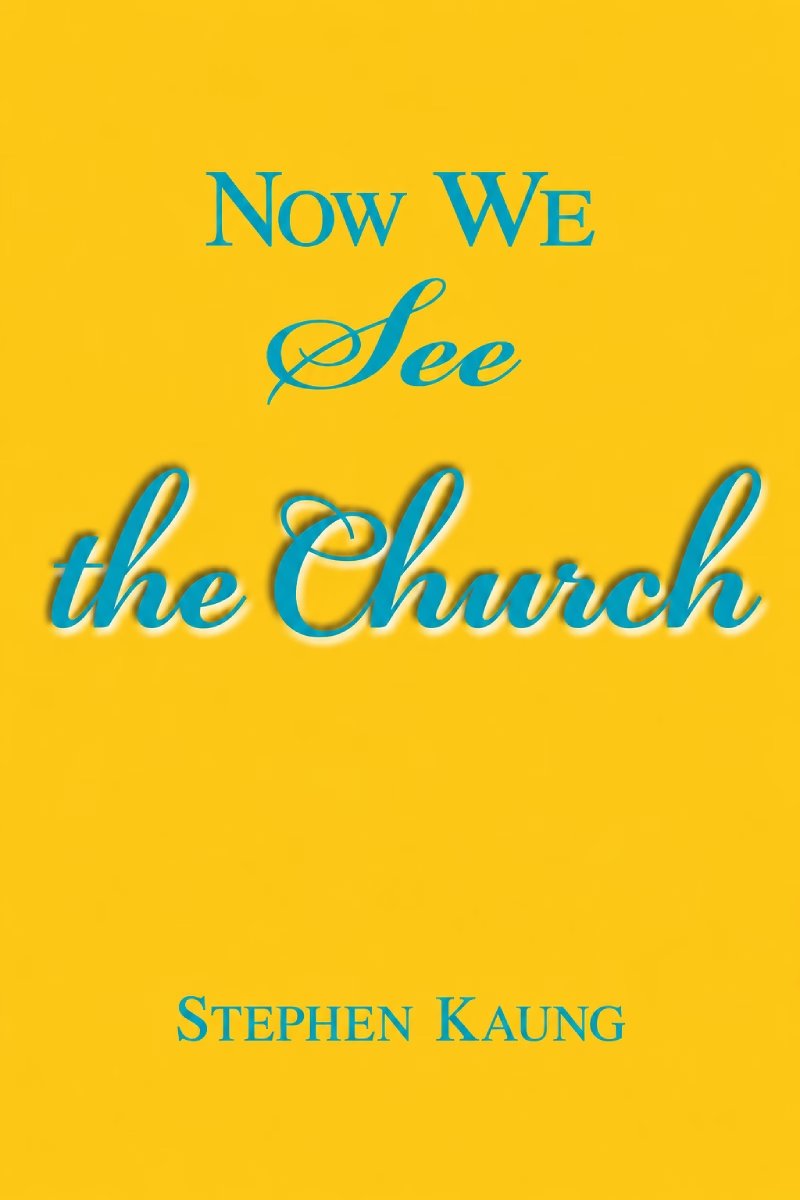
Now We See the Church
Stephen Kaung follows the life of the church from its birth in Acts through Jerusalem, Antioch, Galatia, Philippi, Thessalonica, Corinth, Ephesus, Colossae, and Rome. Seeing the church as the Body of Christ, he draws spiritual lessons from the strengths, problems, growth, leadership, fellowship, and testimony of the first-century assemblies.
Available Instantly
About This Book
Now We See the Church is Stephen Kaung’s extended study of the life of the church as the Body of Christ. Written as a companion to his messages on the life of the Lord Jesus, it begins with Christ’s declaration in Matthew 16:18 that He will build His church and then asks what that church looks like in living, historical expression. Kaung’s central premise is that the church is not a human religious organization produced by Christian effort; it is Christ’s Body, brought into being by God and built by the Lord Himself.
The opening material establishes the Body of Christ and the “mystery of Christ” as foundational concepts. First Corinthians 12:12 and Ephesians 3 are especially significant to the book’s understanding that the church is organically related to Christ. The church is not merely a gathering of independent believers who share beliefs. It is a corporate body whose life, unity, function, and testimony derive from Christ the Head. This provides the theological frame for the historical studies that follow.
Acts then supplies the principal narrative framework. Kaung treats the book of Acts as a panoramic view of the churches in the first century and as a source of spiritual lessons for the church in later generations. The birth of the church at Pentecost receives substantial attention: the Holy Spirit comes upon the waiting believers, the Body appears in history, and the church begins to function as a corporate expression of the risen Christ. Prayer, unity, the working of the Holy Spirit, testimony to Christ, and the shared life of the believers are part of this beginning.
From there the book follows a sequence of actual church settings. Jerusalem shows the earliest corporate life and its strengths and problems. Antioch displays a fresh move of the Holy Spirit beyond the original Jewish setting, believers turning to the Lord, teaching in the Word, fellowship between churches, local leadership, and the emergence of a church able to participate in wider work. The churches in Galatia and the assemblies associated with Philippi, Thessalonica, Corinth, Ephesus, Colossae, and Rome are then reviewed in their historical and biblical contexts. Kaung uses these church histories not merely to reconstruct the past but to ask what each assembly reveals about the life, growth, order, fellowship, problems, and testimony of the church.
The corresponding New Testament letters materially contribute to these studies. Galatians helps explain the churches of Galatia; Philippians, the Thessalonian letters, the Corinthian letters, Ephesians, Colossians, and Romans illuminate the character and needs of the assemblies to which they were written. Acts remains the unifying historical thread, while the Epistles interpret the life seen in those churches. This gives the book a broad New Testament scope without turning it into a verse-by-verse commentary on any single epistle.
One recurring concern is the difference between mere Christian activity and genuine body life. Because the church is the Body of Christ, believers need one another, local assemblies need spiritual reality rather than form alone, and leadership, ministry, fellowship, correction, growth, and testimony must serve the life of the Body. The book therefore speaks both to readers trying to understand the early church and to believers asking what present church life should learn from the first-century assemblies.
For modern search intent, the book answers questions such as: What is the church as the Body of Christ? How was the church born at Pentecost? What can today’s churches learn from Jerusalem and Antioch? Why did churches such as Corinth and Galatia struggle? What characterized the assemblies in Philippi, Thessalonica, Ephesus, Colossae, and Rome? How does the Holy Spirit form and lead a corporate people? Kaung’s purpose throughout is to help readers see the church through its New Testament life and history and apply those lessons to the church’s present calling.
Book Details

Reading Fit
STUDY LEVEL
Intermediate
STUDY SCOPE
New Testament, Topical
BOOKS INCLUDED

Edition & Format
PUBLISHED
November 9, 2015
AVAILABLE FORMATS
paperback, kindle, audiobook
LENGTH
226 pages
· 7h 3m audio

Topics Covered
You Might Also Like