
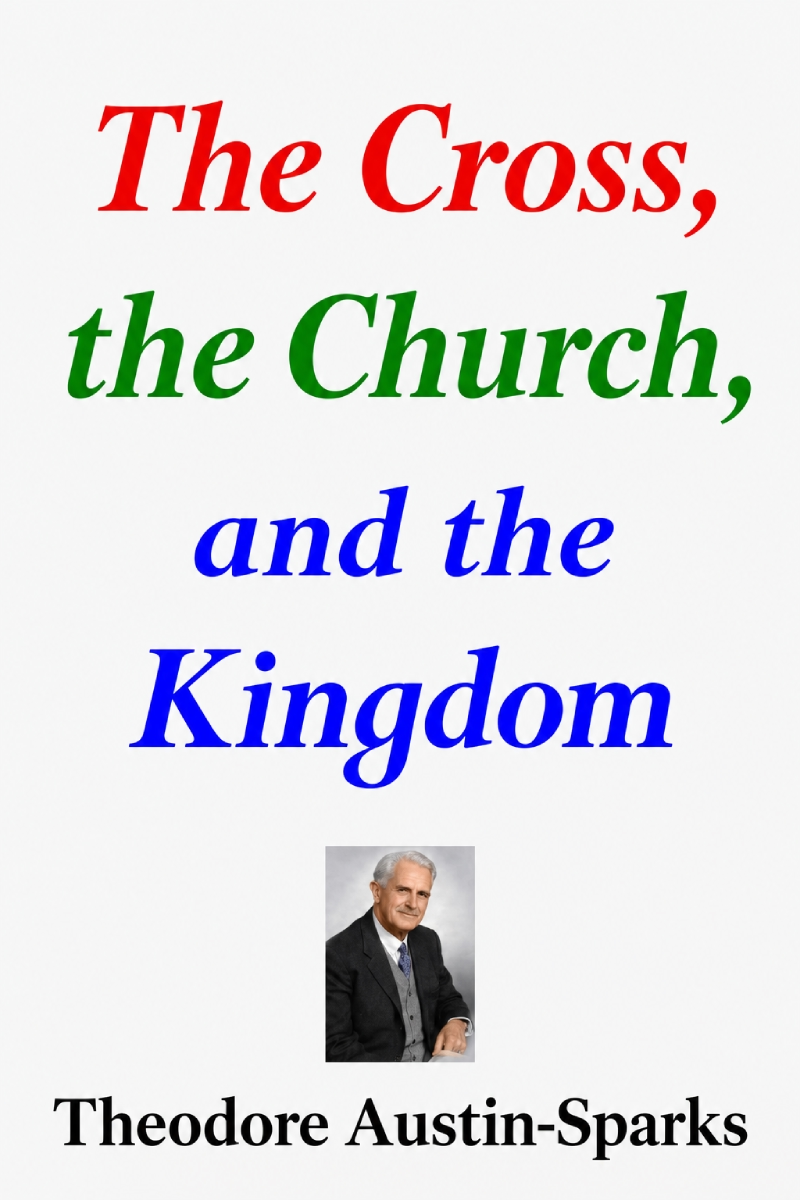
The Cross, the Church, and the Kingdom
T. Austin-Sparks asks what God intended the Cross to accomplish beyond individual salvation, then follows the answer into the Church and the Kingdom of God. Across nine chapters he connects Christ’s triumph, the overthrow of Satan’s kingdom, the Church’s heavenly mission, righteousness, the Holy Spirit, and God’s final purpose of bringing every rival rule under Christ.
Available Instantly
About This Book
The Cross, the Church, and the Kingdom asks what God intended the Cross of Christ ultimately to accomplish and follows that question beyond individual salvation into the Church and the Kingdom of God. T. Austin-Sparks treats the Cross, the Church, and the Kingdom as one continuous divine movement: the Cross removes the ground of the old order, the Church becomes the corporate vessel of Christ, and the Kingdom is the actual rule of God expressed through a people under the lordship of Jesus Christ.
The opening chapter, “The Ultimate Meaning of the Cross,” argues that Calvary cannot be reduced to forgiveness, personal blessing, or even sanctification as separate ends. Philippians 2 contributes the pattern of Christ’s self-emptying obedience, exposing the self-exalting principle opposed to God. The Cross therefore deals with the fallen ground of self, rebellion, and independent human government so that God may recover His rights and obtain a people in whom His will is unchallenged.
The Church then appears as the corporate outcome and instrument of that work. Its heavenly mission depends upon resources that are not natural or institutional. Ephesians 1:19–23 is important to this section because the risen Christ is presented above rule, authority, power, and dominion and as Head over all things to the Church, His Body. The Holy Spirit makes the authority and life of the exalted Christ effective in His people. The Church’s calling is therefore inseparable from Christ’s resurrection, exaltation, and headship.
A major section turns directly to the kingdom of Satan and its overthrow. Sparks presents spiritual warfare as a conflict of governments rather than merely a collection of individual temptations. Satan’s kingdom is characterized by rebellion, self-exaltation, unrighteousness, deception, and death. The Cross judges the fallen Adamic ground on which that kingdom has operated, while the risen Christ stands as Head of a new humanity. Principalities and powers are therefore confronted from the ground of Christ’s accomplished victory rather than through natural force.
The Kingdom of God receives sustained treatment in the middle chapters. Sparks defines the Kingdom as God’s actual rule and domain taking its character from Him. It is not confined to a future age. The Kingdom has come personally in Christ and is to become inwardly real where competing lordships of self-will, preference, and natural desire are displaced. Romans 14:17 contributes the language of righteousness, peace, and joy in the Holy Spirit, while the Church becomes the corporate sphere in which the rule and character of God are to be manifested.
This inward government leads to the practical challenge of the Kingdom. The Kingdom is expressed where Jesus Christ is truly Lord and where the Holy Spirit has liberty to establish God’s values in His people. The Church cannot represent the Kingdom while reproducing the self-centered principle of the opposing kingdom. The Cross therefore remains governing even after conversion because it continually removes what contradicts divine rule.
The later chapters develop the significance of Christ’s death, the triumph of righteousness, and the triumphant Christ with His people. Righteousness is treated as the moral foundation of God’s Kingdom in contrast with the unrighteous nature of Satan’s rule. The final “crowning” brings the argument to 1 Corinthians 15:24–28, where every opposing rule is brought into subjection, Christ delivers the Kingdom to the Father, and God becomes all in all.
The book addresses readers asking what the Cross ultimately accomplishes, how the Church relates to the Kingdom of God, what Satan’s kingdom is, how Christ’s victory over principalities and powers affects the Church, why spiritual warfare is a conflict of governments, how the Holy Spirit makes God’s rule practical, and what it means for Jesus Christ to become Lord inwardly and corporately.
Book Details

Reading Fit
STUDY LEVEL
Advanced, Intermediate
STUDY SCOPE
Topical
BOOKS INCLUDED

Edition & Format
PUBLISHED
May 25, 2012
AVAILABLE FORMATS
kindle
LENGTH
103 pages

Topics Covered
You Might Also Like