

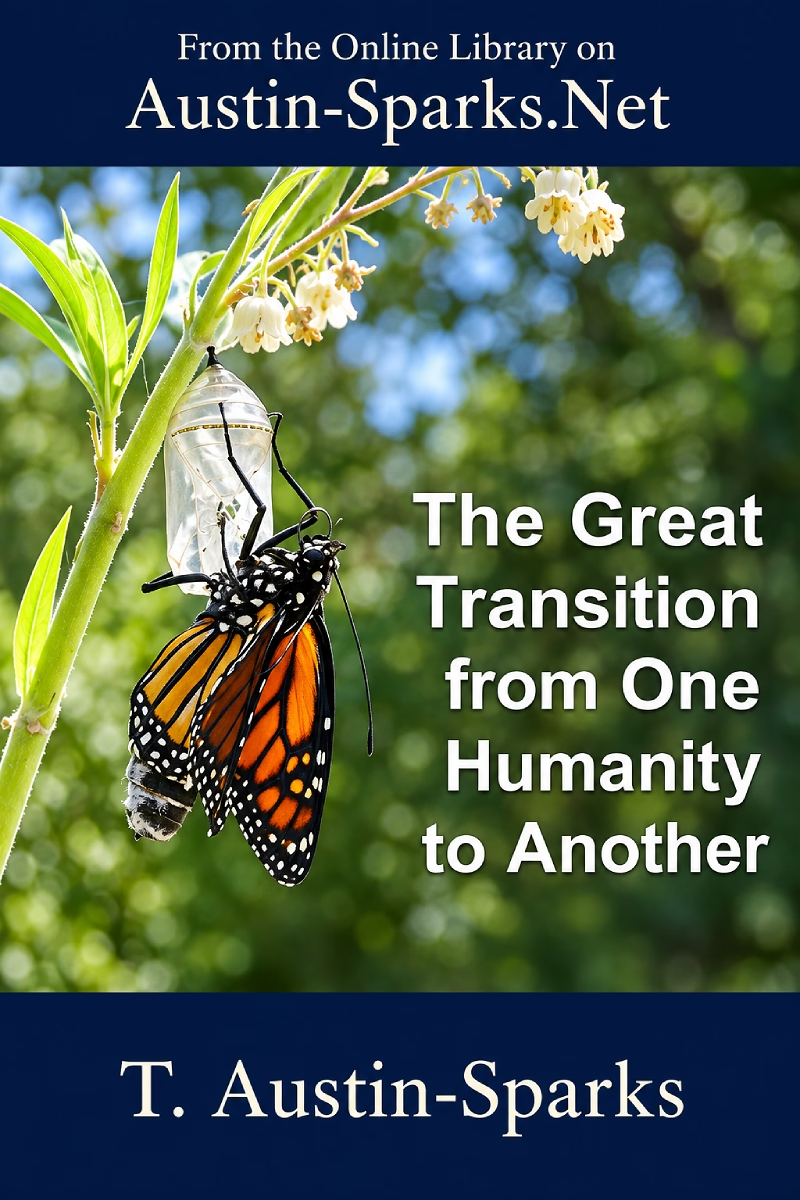
The Great Transition From One Humanity to Another
T. Austin-Sparks traces the New Testament’s great transition from the old humanity in Adam to a new humanity in Jesus Christ. Through the Cross, the Corinthian conflict between natural and spiritual life, the Holy Spirit, and the vision of Christ crucified, risen, and exalted, he shows how God displaces Adamic resources so Christ may become the life and corporate expression of a new creation.
Available Instantly
About This Book
The Great Transition From One Humanity to Another presents the New Testament as the record of a decisive change from the old humanity in Adam to a new humanity in Jesus Christ. T. Austin-Sparks describes this not as the improvement of human nature but as a transition between two sources, two orders, and two representative men. Adam stands for the natural humanity that cannot fulfill God’s intention; Christ crucified, risen, and exalted is the beginning, standard, and life of another humanity. Regeneration therefore means entrance into a new creation rather than the religious repair of the old.
The opening message places this transition within the broad biblical movement from Adam to Christ. Genesis 5 and 1 Corinthians 15 supply foundational language for humanity represented corporately in a head. Sparks also uses John and Hebrews to show that the New Testament replaces old forms and natural ground with realities centered in Christ. The governing question is what God intended humanity to be and how that purpose is recovered and realized in His Son.
The old humanity is treated both individually and corporately. It includes natural strength, self-interest, human wisdom, soul-force, self-expression, and the attempt to carry natural resources into spiritual work. Sparks insists that God is not gradually educating this source until it becomes suitable. The Cross marks God’s decisive judgment upon the Adamic ground and creates a boundary between the old humanity and the new. Christian difficulty arises when what belongs to the old source is carried across that boundary into the sphere of Christ.
First and Second Corinthians form the book’s principal battleground. Sparks treats the Corinthian letters as a concentrated New Testament exposure of the conflict between the two humanities. First Corinthians 2 contrasts the natural man with the spiritual man; divisions, rivalry, worldly wisdom, religious display, and misuse of gifts reveal how genuinely Christian people can still act from the old humanity. First Corinthians 15 then brings Adam and Christ, death and resurrection, and the future transformed body into the same great transition. Second Corinthians shows the practical reduction of natural strength through weakness, pressure, suffering, and the sentence of death so that the life and power of Christ may be manifested in the vessel.
The Cross of Christ is central throughout. It is not presented only as the ground of forgiveness, but as God’s cleavage between Adam and Christ. The practical work of the Cross exposes confidence in natural ability and removes the ground on which the old humanity acts. Resurrection introduces a life that does not arise from Adamic resources, and Christ’s exaltation establishes the heavenly Man as God’s governing standard.
The Holy Spirit is indispensable to the transition because the natural person cannot perceive or produce the new humanity. Spiritual sight, revelation, discernment, and power belong to the Spirit. Sparks’s fourth message therefore emphasizes an all-governing vision of Jesus Christ: transformation occurs as believers see Christ as God’s measure and are brought away from self-measurement, natural standards, and religious systems toward conformity to Him.
The Church is the corporate expression of this new humanity. Local church life, ministry, and spiritual gifts are judged by whether they increase and express the measure of Christ. True ministry does not originate in natural personality, eloquence, strength, or technique; its nature and dynamic are the communication of Christ by the Holy Spirit. Second Corinthians becomes especially important here because apostolic ministry is shown as life coming through a vessel whose natural sufficiency has been broken.
Sparks also uses Israel’s wilderness history as a supporting biblical picture of a people who experienced real deliverance yet remained marked by natural appetite, unbelief, division, and immaturity. The warning reinforces the distinction between an accomplished transition in Christ and its practical realization in God’s people.
The book addresses readers asking what the old man and new man mean, why Christians can remain governed by natural or soulish resources, what the Cross must accomplish in practical life, how spiritual transformation occurs, why suffering may reduce self-sufficiency, how the Holy Spirit produces spiritual perception, and what the Church is meant to become. Its answer is consistently Christ-centered: God’s goal is a new humanity in which the character, life, mind, and corporate expression of Jesus Christ increasingly displace the old humanity in Adam.
Book Details

Reading Fit
STUDY LEVEL
Advanced, Intermediate
STUDY SCOPE
New Testament, Topical
BOOKS INCLUDED

Edition & Format
PUBLISHED
July 9, 2012
AVAILABLE FORMATS
kindle
LENGTH
118 pages

Topics Covered
You Might Also Like