
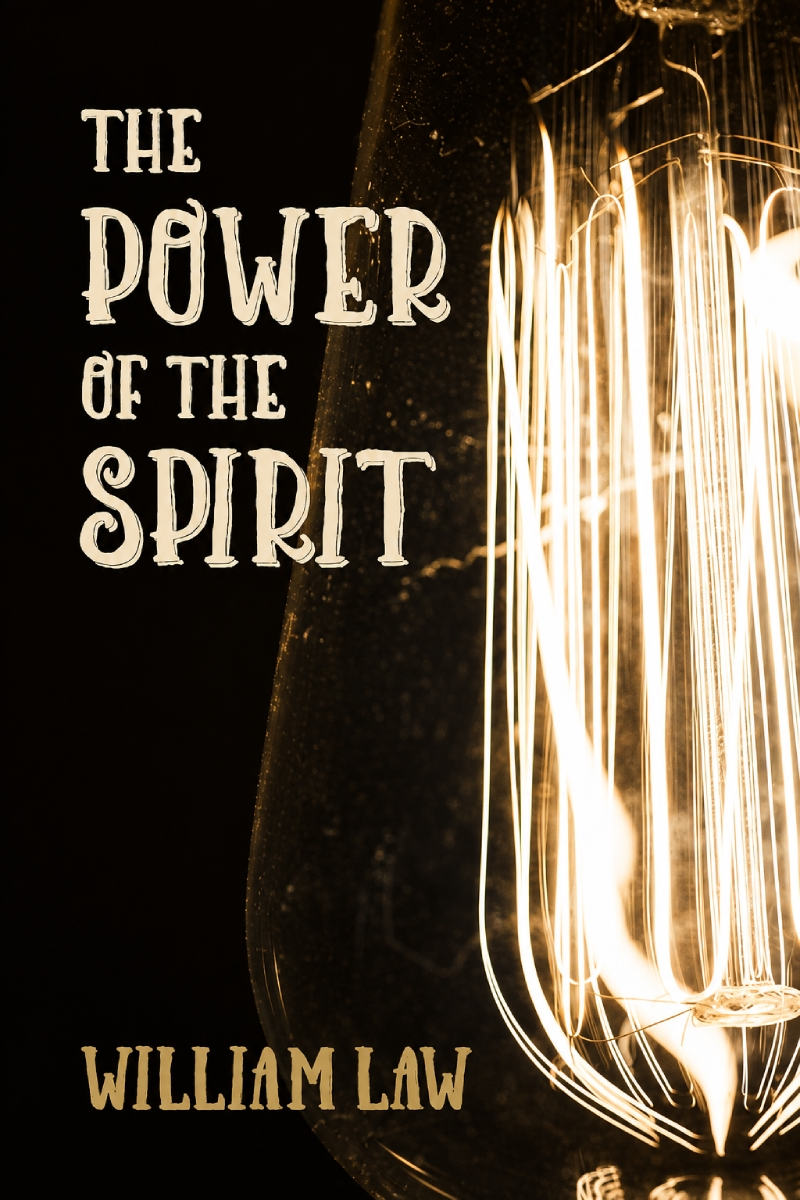
The Power of the Spirit
William Law presents the Holy Spirit as the indispensable source of true Christian life. He contrasts continual dependence on the indwelling Spirit with religion reduced to words, natural reason, learning, pride, or self-effort, then applies that principle to Scripture, Christ within, the Church, spiritual knowledge, revival, holiness, victory over sin, and faith expressed in works.
Available Instantly
About This Book
The Power of the Spirit gathers and modernizes William Law’s teaching on the Holy Spirit, drawing on the earlier Andrew Murray collection and other Law writings. Across its sixteen major chapters, one principle governs the book: Christianity depends continually on divine life communicated by God through His Spirit. Spiritual reality cannot be produced by natural reason, religious form, intellectual information, or disciplined self-effort because the life God requires must come from God Himself.
The opening argument places the indwelling Spirit within salvation. Law begins from the conviction that goodness belongs to God and that a fallen person cannot generate divine life from within natural powers. The new birth therefore requires the Spirit of God, and the Christian life requires an ongoing supply of the same divine life. Dependence on the Holy Spirit is not presented as an occasional resource for unusual moments but as the normal condition of true Christianity.
That conviction governs Law’s treatment of Scripture. Several chapters distinguish the letter from the Spirit and natural understanding from spiritual knowledge. The Word of God is not dismissed or minimized; rather, Law argues that merely possessing biblical words and concepts is not the same as receiving the reality to which Scripture testifies. The Holy Spirit must illuminate, apply, and make inwardly living what the written Word declares. This is why the book repeatedly challenges religion that is correct in form yet lacks inward divine operation.
Natural reason and worldly wisdom receive sustained scrutiny. Law does not deny the usefulness of reason in its proper sphere, but he denies that human intelligence can originate spiritual knowledge, holiness, worship, or divine life. The Christian must therefore surrender confidence in self-derived wisdom. Self-denial includes the denial of intellectual and spiritual self-sufficiency, while pride is exposed as resistance to the continual receiving posture on which life with God depends.
The book also develops the Holy Spirit’s continuous inspiration or leading. Law uses this older language to describe the believer’s uninterrupted dependence on the present work and guidance of the Spirit, not the production of new Scripture. The question is whether Christian life is actually lived from God’s inward activity or merely from memory, habit, institutional form, and natural ability.
Christ living in the believer is a major expression of this same principle. Jesus Christ is not presented only as an external historical example; His life is made inwardly effective by the Holy Spirit. Union with Christ therefore means that Christian character and obedience arise from a life received rather than from self-generated imitation. The new birth, indwelling Spirit, and Christ within belong to one movement of divine life.
Law applies the argument corporately to the Church. The Church is a habitation of the Spirit, and genuine spiritual unity depends on the one Spirit rather than on outward uniformity alone. Decline occurs when human wisdom, form, or organization displaces dependence on the Spirit. Reformation and revival therefore require more than structural correction: they require renewed inward submission to the Spirit’s life and government.
Individual chapters also address baptism with the Holy Spirit and the unpardonable sin against the Holy Spirit. These subjects are treated within the book’s wider insistence that the Spirit is not an optional addition to Christianity but essential to its life, knowledge, worship, and power.
The final movement applies the same principle to holiness and conduct. Victory over sin is not achieved by the natural self becoming religiously stronger; a stronger divine life must operate within. Sanctification is therefore tied to the Spirit’s inward work. Faith and works are brought together by the same logic: living faith produces action because both arise from the life of God rather than from an attempt to manufacture spiritual goodness independently.
The Power of the Spirit addresses readers asking what it means to depend continually on the Holy Spirit, why the indwelling Spirit is essential to salvation and Christian living, how Scripture becomes spiritually understood rather than merely known intellectually, how Christ lives within believers, why reason and learning cannot substitute for spiritual knowledge, how pride and self obstruct divine life, what gives the Church true unity and renewal, and how the Spirit produces holiness and victory over sin.
Book Details

Reading Fit
STUDY LEVEL
Advanced, Intermediate
STUDY SCOPE
Topical
BOOKS INCLUDED

Edition & Format
PUBLISHED
January 27, 2017
AVAILABLE FORMATS
paperback, kindle, audiobook
LENGTH
152 pages
· 5h 18m audio

Topics Covered
You Might Also Like